.png)
Direct Answer Dominance - The Rise Of Zero-Click Search
The current search environment is largely defined by a desire for immediacy and contextual accuracy, meaning user behaviour has moved away from fragmented keyword searches (e.g. "best marketing agency") toward conversational, full-sentence queries (e.g. "What is the best marketing agency in New Zealand for small businesses who work with you as a marketing partner"). This change stems from users now expecting a more curated and direct answer rather than a list of ranked links (that still require additional manual research).
This AI Search behaviour has moved us into the "zero-click” era, where users' needs are satisfied directly within the search platform or AI tools without requiring the user to visit the source (the website). Consequently, content that is optimised solely for traditional blue-link ranking is becoming less effective, and must now be optimised to provide direct, contextual answers, or it risks being overlooked entirely by the AI models powering these new search experiences.
The reality is that a successful overall online search strategy must now expand the visibility layer of modern search, ensuring pages earn visibility through both traditional clicks and AI citations using SEO, AEO and GEO optimisation methods.
Answer Engine vs Generative Search
While AEO focuses on optimising existing content for direct extraction, a parallel strategy is Generative Engine Optimisation (GEO). GEO is concerned with influencing how Large Language Models interpret, rephrase, and synthesise content when generating AI-driven outputs (like AI Overviews).
The distinction between these two layers is important for digital marketing specialists and business owners when looking at their content creation strategies. In summary:
- AEO depends on how well a page is structured for extraction (focusing on markup, scannable answers, and definition patterns).
- GEO depends on how well a topic or brand is represented within the generative language model (focusing on embedding presence, contextual relevance, and brand accuracy in the model’s outputs).
For businesses, SEO serves as the foundational step establishing the basics, followed closely by success in AEO, then GEO. Meaning, if content is not structured correctly for extraction, and cited and trusted by retrieval models the AI retrieval layer cannot identify it as a high-quality, extractable answer for GEO purposes. Therefore, establishing a solid SEO/AEO framework is necessary to achieve positive GEO outcomes, for example, sustained inclusion and accurate representation in AI summaries.
What all this means for small businesses is that they must focus on all optimisation layers because SEO, AEO and GEO currently all coexist in the generation of modern search results. Where AEO was built naturally on existing SEO knowledge, GEO is built on a good solid AEO foundation.
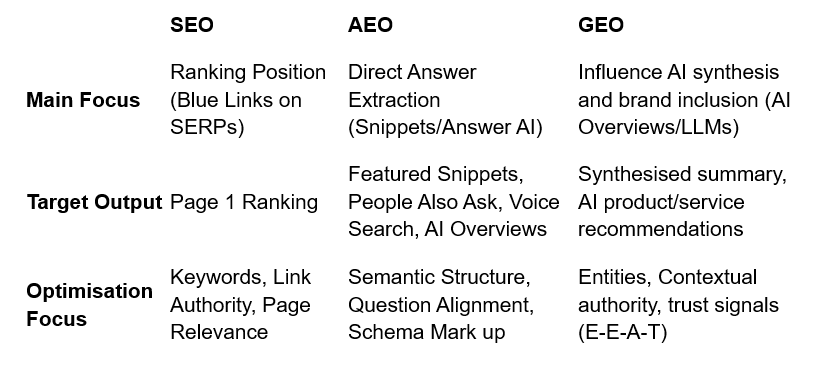
SEO vs AEO vs GEO – Quick Comparison
The following table summarises the strategic differences between the three main optimisation approaches.
Content Production For AI Search Tools
So what all this means is that when we get down to it, when we are looking at content generation, we are actually taking a comprehensive targeted approach utilising all aspects of SEO/AEO and GEO.
How To Write For Answer Extraction (AEO)
The content strategy for AEO begins with a good foundation of traditional SEO practices while developing an ideal structure or adapting the writing style to be as conducive as possible to machine extraction (while still producing quality content of course!). Here are our top AEO content writing tips:
1. Make Content Easily Scannable
Always organise information into scannable sections where each block is designed to satisfy a single user intent. The reason why this is important is because answer engines extract information in small chunks of text rather than processing an entire page. Consequently, every block of content should be structured to answer one user query fully.
2. Use Natural Language
All content must also be clear, concise, and structured using natural language for easy interpretation. Or, in other words, try to write as you would talk and get straight to the point!
3. Think Entity-Based
To enhance machine comprehension, AEO content should incorporate what is referred to as "Entity-Based Triads". This technique involves repeating core terms using a three-part structure that mirrors how AI systems identify authoritative definitions, providing high factual density in an easily scannable format. This involves structuring core concepts as follows:
- Start the answer with “[Entity] is [definition]” (Who/What/Where – Answer first)
- Add a component stating “[Entity] includes [attribute]” (Features)
- Finish with “[Entity] matters because [importance]” (Benefits/Why it matters)
4. Question-Driven Formats Are Best
Web page content needs to signal to AI tools what questions are being answered clearly and explicitly, this is usually achieved through the deliberate use of headings, formatting, and semantic HTML. What this might look like is phrasing H1s, H2s and H3s as the actual, full-sentence questions that users type into a search engines.
For example, a small business should use a heading like “What Does Answer Engine Optimisation Mean?" instead of a disconnected phrase like just "Answer Engine Optimisation". This strategy directly aligns the content with search intent, drastically increasing the chance that an AI search engine will feature the content when that exact question is asked.
5. Front-Loaded Answers First
One of the foundational AEO content principles is the “Inverted Pyramid” concept, where the writer answers the core question as soon as it is asked in the content. For example, immediately following the question-based heading should be a direct, concise answer.
The idea here is that this "front-loaded" question and answer format serves as an easily extractable “snippet” for use in AI-generated answers. Follow up with more detail immediately after the initial answer using supporting research, data and context to work towards establishing authority (E-E-A-T).
6. Stick With Extraction-Friendly Formats
Content that is broken down into formats that are easily digestible for both users and search engines is highly desirable, this might include:
- Lists: Bullet points and numbered lists are appropriate. All lists should be preceded by a brief sentence that introduces the list's purpose/description.
- Tables: Ideal for data comparisons, pricing tiers, or highlighting features, a small HTML table is highly effective because it is easily pullable into search results and helps AI in understanding comparative relationships within the data. Tables should always be formed with clear headings to maximise their effectiveness.
- Hierarchical Structures: Content must be organised using proper nesting of headings (Only one H1 on the page, H2s for main sections, H3s for subsections) to signal how information is grouped and related clearly. Always avoid long chunks of text under a single heading – use white space to break it up, or make new subheadings.
3 Core Strategic AEO Content Opportunities To Action Now!
Small businesses should prioritise developing content types that inherently align with AEO’s question and answer preferences. This includes making sure you have the basics covered such as:
- Comprehensive FAQs Pages. Developing a detailed Frequently Asked Questions (FAQ) page to answer anything and everything a potential customer might ask efficiently addresses high-intent user queries. This content is highly conducive to both content extraction and the application of structured data.
- How-To Guides/Instructional Content. Content providing step-by-step guides is perfect for user intent-focused queries and particularly useful in voice search. This type of content should be structured using ordered lists.
- Pricing And Comparison Pages. Particularly useful in addressing cost vs benefit search queries and a determining factor in many purchase decisions, pricing pages should be optimised to provide clear, direct answers to common cost-related queries. Using structured tables is crucial here.
Bonus AEO Tip
For small local businesses, data integrity (NAP consistency) represents the single greatest priority, offering quantifiable increases in high-value local visibility. Ensure all team members adhere to an exact, standardised format for NAP details, avoid variations like always use “Street” instead of “St”. Also the Name, Address, and Phone number must be present in plain, crawlable text on the website (typically the footer and contact page), is should not be an image or graphic. This visible, plain text must then be mirrored precisely in all online instances of the business across the web, maximising search accuracy.
Building Trust With GEO Targeted Content
While AEO works to secure more immediate tangible wins via AI snippets, long-term visibility within generative AI outputs requires a deeper strategic focus on authority and technical accessibility, commonly referred to as Generative Engine Optimisation (GEO). This strategy aims to embed the brand's identity and expertise deep within the generative tool’s learnings.
1. Always Adhere To The E-E-A-T Guidelines
Experience, Expertise, Authoritativeness, and Trustworthiness still apply at all levels, the E-E-A-T principle still holds strong as necessary under GEO rules to ensure that the answers presented to the user are reliable, factual, and trustworthy.
For small businesses, the easiest way to demonstrate expertise within the AI realm is transparency. What this might look like is detailing the credentials and biographies of key personnel (staff/content authors) alongside delivering consistently high-quality content – the aim is for the AI algorithm to perceive the page as having low bias and high factual reliability.
2. Shift The Content Focus From Sheer Volume To Verifiability
LLMs are predisposed to favour content that contains expert commentary and professional insights. When an LLM processes a topic, the inclusion of specific, unique quotes and detailed perspectives from subject matter experts provides an essential signal of credibility.
Strategically, businesses must back up statistical claims, industry analyses, or any significant assertions with external links to reputable, high-authority sources, such as scientific studies or industry reports. For example, instead of making a general statement like, "AEO boosts traffic," the claim should be supported by an assertion such as, "According to a study by XYZ, implementing AEO strategies increased organic traffic by 30%". This actionable citation strategy provides machine-verifiable data, making the content instantly more appealing to AI platforms.
3 Core Strategic Content Opportunities For GEO To Action Now!
GEO is the strategic effort to ensure a brand's presence is established within the broader ecosystem that LLMs draw from, influencing all generative responses whether you are using ChatGPT, Gemini or something else. Here are 3 core things you can do to improve your content on your website now:
- Build Your Brand Presence Online. A brand's online presence (or lack of) on influential third-party sources significantly influences how LLMs respond to brand-related queries. This involves building "notable third-party coverage", a process that embeds the brand's expertise and identity deeper within the generative model’s knowledge and understanding.
- Monitor LLM Outputs. Competitive analysis for AEO/GEO must evolve past traditional keyword rankings. Small businesses should conduct manual sampling, testing key product or service queries across different LLMs to identify patterns in how their brand appears in generative responses compared to competitors. Key performance metrics for GEO include citation frequency by content type, the specific context of brand mentions (product recommendation vs. educational explanation) and the accuracy of product descriptions within the AI summary.
- Keep An Eye On The Technical Aspects (Accessibility and Speed). AI crawlers require optimal technical conditions for continuous, efficient (and speedy) information retrieval. This means ensuring that content is structured well and accessible with clean HTML and a clear, logical hierarchical structure, with key information placed high up in the content flow for faster processing and retrieval. Plus, site speeds are and always have been an important factor for all search tools and will remain so.
The transition from traditional SEO to optimising for all three (SEO, AEO and GEO) is not optional. It is essential for small business' visibility in the AI search era. Interested in implementing more AEO and GEO content strategies for your business? Give the team at Digital Influence a call today.