Picture a management meeting where the first item on the agenda isn't the pipeline or the P&L. It's each person saying a number out loud, a score out of ten for their headspace, their health, and how things are going at home. In front of everyone else. Twice a month.
Most business owners would find that excruciating, which is exactly why their team check-ins produce nothing.
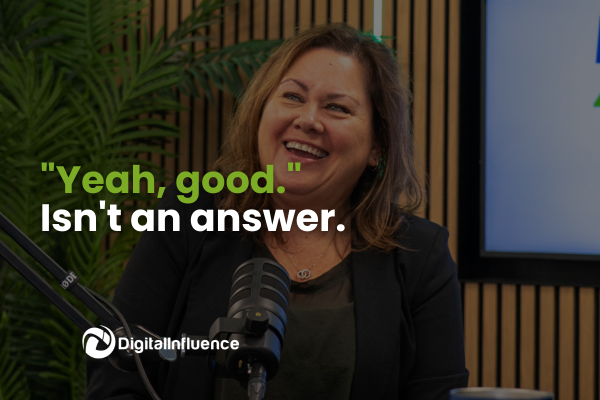
You know the pattern. "How's everything going?" "Yeah, good." Six weeks later someone hands in their notice and you discover they'd been running on empty since autumn. The check-in happened. It just didn't tell you anything.
There's a better version, and it came up in a conversation on the Marketing 4 Business podcast. Andrea Cockburn, who has spent around forty years in sales and co-owns a Christchurch window and door business, runs a ten-minute scoring exercise with her management team. She also raises a question that has to be answered before any of it works.
Why "how's everything going?" gets you nothing
Open-ended questions put the entire burden on the other person. They have to decide how honest to be, how much detail is appropriate, whether now's a good time, and whether saying "actually, not great" will cost them something. Faced with all that, almost everyone picks "yeah, good."
Numbers remove the negotiation. Asking someone to score their headspace out of ten doesn't require them to explain, justify or perform. They just say a number. And a four is impossible to wave away in a way that "yeah, bit tired" isn't.
The tank: four numbers, said out loud
The tool is called "the tank," and it's about as low-tech as it gets. Each person scores themselves out of ten across four gauges:
GaugeWhat it's actually askingMindsetHow's your headspace and energy for work right now?HealthPhysically, how are you tracking? Sleep, training, illness, recovery.FamilyWhat's the temperature at home?PersonalEverything outside work and family that's yours.
One is the bottom of the barrel. Ten is great, but it isn't a ceiling. If you feel better than a ten, say so. The point isn't precision, it's a shared reference number everyone in the room can hear.
Cadence: a full round monthly, plus a fortnightly check-in. So twice a month, roughly ten minutes at the top of a meeting.
That's the whole tool. The rules around it are what make it work or fail.
The rules matter more than the tool
Most companies attempt something like this and end up with an anonymous pulse survey nobody reads, or a wellbeing initiative that quietly dies. Five things separate the version that sticks.
1. Say it out loud, not on a form. Anonymity feels safer, and it's why surveys generate data instead of conversations. Saying "my health tank is at four" to three colleagues creates an obligation in the room that a spreadsheet never will.
2. The leader scores first. If you go last, everyone calibrates to you. If you go first and say seven when it's really a four, you've just taught the team the acceptable answer.
3. There's only one response: "what do you need?" Not "have you tried," not a solution, not a plan. Sometimes the answer is "nothing, saying it out loud was enough today." Sometimes it's "my family need me more this month, so I'll be less available here." Both are complete answers.
4. Take yourself out of it. This is the hard one. When someone says their family tank is at four and they need to step back, the owner's brain immediately runs the cost: that has a flow-on effect, that's going to cause me headaches, we've got the busy period coming. The moment that shows on your face, you've contaminated every future score. Your job isn't to react to the number. It's to help move it from a four to an eight.
5. Don't roll it out formally to the whole team. This is the most counterintuitive rule, and it's the one most likely to save you from a failed initiative. The tank runs formally at management level only. With the wider team, the same thinking gets translated into ordinary human questions: noticing someone's under pressure and telling them to knock off early, asking what would help. Nobody wants to be handed a wellbeing form by their employer. They'll take the question when it's asked like a person, not a process.
The question that comes before any of this
Here's where it gets uncomfortable, and it's the part almost nobody writes about.
Running good check-ins is pointless if you're using what you learn to push people toward a future they never asked for.
Most owners are ambitious by definition. You don't start a business without wanting to break through your own ceiling. The assumption that follows is so automatic it barely registers: everyone wants that. So you book the course. You fund the qualification. You create the pathway. And then you feel let down when the person doesn't grab it with both hands.
Andrea put it plainly. She'd spent years wanting every person around her to push through their own glass ceiling. What she'd never done was ask whether they wanted to.
She also named the reason honestly: you want the best for the person, and you want the best for your business. Both are true at once, and the second one is easy to dress up as the first.
Skill ceiling vs mindset ceiling
Her distinction is the useful part. Someone's skill might sit at one level while their mindset sits below it. Train the skill and the mindset stays put, and the training goes nowhere. Same course, same cost, no movement.
Two people can look identical on a capability matrix and need completely different things:
Where they actually areWhat most owners doWhat to do insteadWants to grow, ready for itBook the trainingInvest properly, and name the path out loud so they know it's realWants to grow, mindset not there yetBook the trainingWork on the belief first. Small wins, visible ones, before the qualificationHappy where they are, excellent at the jobKeep talking about their "potential"Let them be brilliant where they are. Contentment isn't a deficiencyNot interested, and not meeting the standardBook the trainingThis is a performance conversation, not a development one. Different meeting
There's a fourth possibility worth sitting with. Sometimes it isn't the person's ceiling at all, it's the combination. Your company's way of operating and their way of operating simply don't fit, which is nobody's failure, but it does require a hard conversation rather than another training budget.
Why this protects you, too
There's a version of employer generosity that looks like leadership and functions like a slow leak. You over-give, you're disappointed, you give more to fix the disappointment.
One of Andrea's own managers cut through it with a line worth taping to your monitor, roughly: not everyone in your team is your family or your child, and you don't have to spoil them all. Team means everyone gives and receives. It was never the employer's job to only give.
The check-in and the question work together here. The tank tells you what's actually happening with your people. Asking whether they want to grow stops you pouring effort into a future only you can see. Between them, they replace guessing and over-giving with something you can act on.
Run your first one this month
Pick your next leadership meeting and spend the first ten minutes on it:
- Name the four gauges before you start, so nobody's guessing what's being asked
- Score yourself first, and score honestly
- Go around the room, number only, explanation optional
- For anything under six, ask one question: what do you need?
- Write down what people said they needed. Follow it up in a fortnight
- Book the next one now, or it won't happen
Then, separately, before you spend another dollar on developing someone, have the conversation you've probably been skipping. Ask them where they want to be in two years. Then believe the answer, even if it's "right here, doing this well."
Andrea's full conversation with Scott Wilson on the Marketing 4 Business podcast covers plenty more, including how she changed the culture of a business she'd bought without losing the staff, and what she calls "stop, start, recreate." Worth an hour of your commute.
Want the full conversation? Listen to "From State House Kid to Multiple Business Owner: 40 Years of Sales, Culture and Boundaries" with Andrea Cockburn on the Marketing 4 Business podcast, available on your favourite podcast streaming service, or watch it now on YouTube.